Hayward Pool Pumps: 2026 Model Lineup, Prices, and Best Buys
Affiliate disclosure: PoolPump.com earns a commission if you buy through some of the retailer links below. That does not change your price. Full policy on the affiliate disclosure page.
Key takeaways
- Hayward’s main in-ground variable-speed lines are the TriStar VS, Super Pump VS and MaxFlo VS. Matching the family of the pump you are replacing usually keeps plumbing changes, and labor, to a minimum.
- Under the federal efficiency rule in effect since 2021, most replacement pumps for in-ground pools are variable-speed models.
- A Hayward that hums but will not start usually needs a $20 to $40 start capacitor, not a new pump. See the capacitor guide.
- Check the warranty terms before a DIY install; some coverage depends on professional installation.
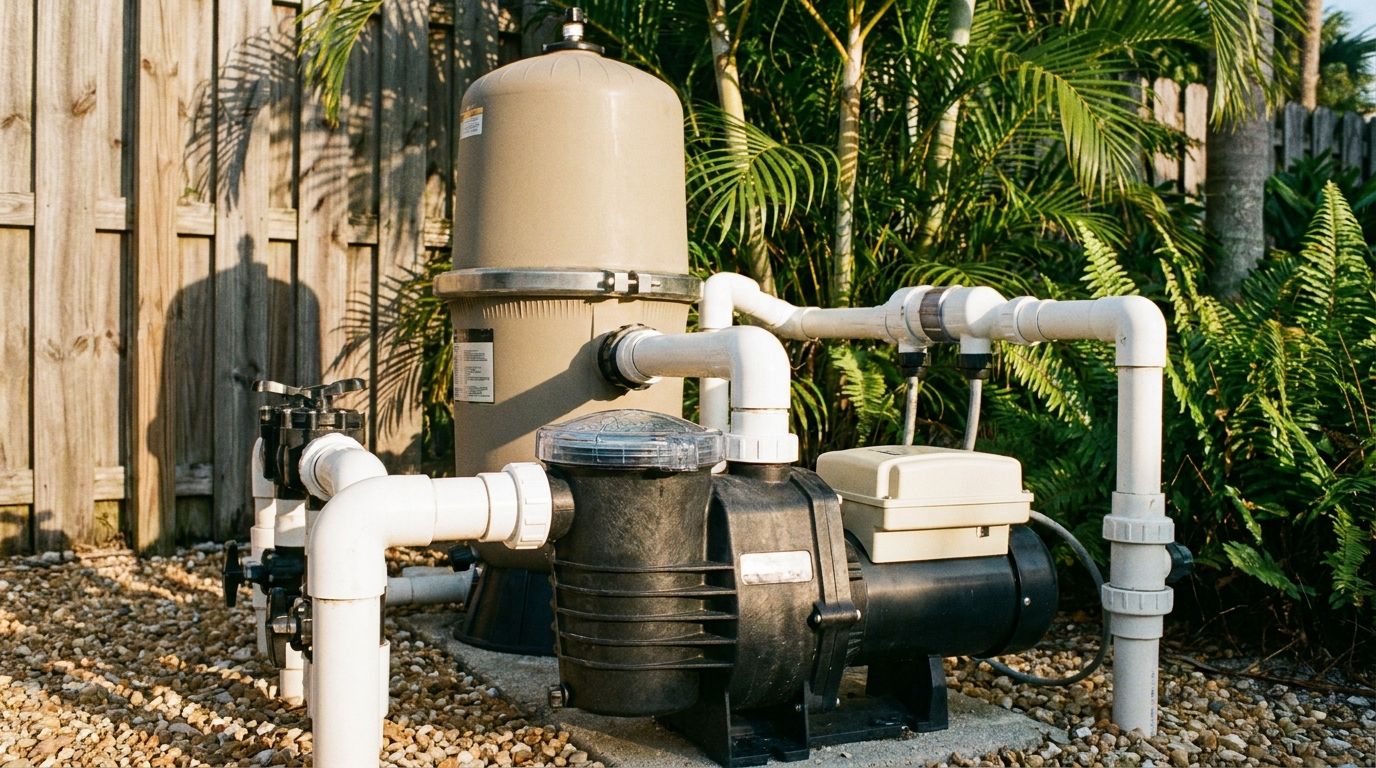
Hayward is the pool pump most residential owners meet first. If you inherited a pool with the house, there is roughly a one in three chance the pump on the pad already has a Hayward badge on it. The company has been building residential pool equipment since the 1920s and its distribution runs through nearly every pool store in the country.
That distribution is also why Hayward is worth understanding before you buy. The lineup is broader than it needs to be, model names change every few years for the same part, and the price gap between the “same” pump at a big-box store versus a dedicated pool retailer routinely runs $150 to $400. This guide breaks the lineup into the three questions that actually matter: which pump fits your pool, which model is the right point on the price-versus-reliability curve, and where you buy it without overpaying.
When Hayward is the right choice
Hayward makes sense when parts availability and local service matter more than absolute peak efficiency. Every regional pool distributor stocks Hayward capacitors, seal kits, and motor replacements, which means a Saturday morning failure in June can be a same-day fix instead of a two-week Amazon wait. If you plan to do your own maintenance, the Hayward ecosystem is the friendliest to a first-time owner with a socket set.
Where Hayward is not the right choice: if you want the quietest, most efficient variable-speed pump on the market with the tightest control software, Pentair’s IntelliFlo3 still owns that seat by a small margin. If you want the cheapest reliable pump and do not care about the badge, Waterway is often $100 less for the same duty. Hayward is the sensible middle.
The 2026 Hayward lineup, by category
Variable-speed pumps (the money category)
Variable-speed is where every new install should land in 2026. The Department of Energy’s pool pump rule effectively bans new single-speed pumps above 1 THP for residential in-ground use, and most utilities offer $150 to $500 rebates for switching. Hayward’s variable-speed line-up:
For a brand-agnostic overview of variable-speed pool pumps (the DOE rule, real payback math, and top 5 models compared), see the variable-speed pool pump buying guide.
TriStar VS 900 (Hayward’s flagship residential VS), 2.7 THP, 8 programmable speeds, WiFi-ready via the Omni controller. Rated for pools up to 40,000 gallons with realistic head. Retail: $1,300 to $1,600. This is the pump to buy if you want to run at 1,200 RPM for filtration and only spike to full speed for the vacuum. Payback on energy savings versus a single-speed is typically 14 to 22 months in a hot climate.
SuperPump VS 700, 1.65 THP, 4 speed presets, no WiFi. The “I don’t want an app” variable-speed pick. Retail: $900 to $1,150. Better value than the TriStar for smaller pools (under 20,000 gallons) or owners who set it once and never touch it.
MaxFlo VS 500, the entry variable-speed, 1.65 THP with a simpler control panel. Retail: $700 to $850. Fine for smaller above-ground and small in-ground pools where the rebate covers most of the delta over a single-speed.
Where to buy: Doheny’s typically prices the TriStar VS and SuperPump VS $50 to $200 below Amazon’s mid-tier resellers, and their shipping is included over $50.
Search Hayward variable-speed pumps on Doheny’s
Search Hayward variable-speed pumps on Amazon
Single-speed pumps (still legal in specific cases)
Single-speed is still allowed for above-ground pools, seasonal-drain pools, and replacement of like-for-like units under 1 THP. The lineup:
SuperPump 700 (single-speed, 1 THP), the workhorse. If you have an older pool with a bonded pad and want to replace the motor plus wet-end together without changing plumbing, this is usually the drop-in match. Retail: $450 to $580.
MaxFlo XL (single-speed, 1 or 1.5 HP), Hayward’s budget in-ground single-speed. Fine for pools under 20,000 gallons with simple plumbing. Retail: $380 to $475.
Practical note: paying $450 today for a single-speed you will legally have to replace inside three years, when the ban tightens on replacement units too, is a bad trade for any pool over 15,000 gallons. Spend the extra $250 on a MaxFlo VS instead.
Above-ground pumps
PowerFlo Matrix, the pump 80% of above-ground owners end up with. 1 to 1.5 HP, standalone or paired with the Hayward sand filter combo. Retail: $220 to $340 for the pump alone, $500 to $700 for the pump-plus-filter combo.
PowerFlo LX, an older-generation option still on shelves and often $50 cheaper than the Matrix for the same duty. The trade-off is the seal life; the LX averages about 3 years of continuous seasonal use before the shaft seal needs replacement, versus 4 to 5 for the Matrix. Sizing by pool diameter and the Intex and Bestway alternatives are in the above-ground pool pump guide.
Search Hayward above-ground pumps on Amazon
Booster pumps (for suction-side cleaners)
Booster Pump (1 HP), the pump that powers Polaris and Hayward Navigator cleaners. Not a replacement for the main pump. Retail: $340 to $420. Almost identical to the Polaris PB4-60 in performance; buy whichever is cheaper the week you need it.
Hayward versus Pentair, the honest comparison
The Hayward-versus-Pentair question comes up on every pool forum, and the honest answer is that both brands make reliable variable-speed pumps and the differences are narrower than either brand’s marketing suggests. For the model-by-model view from the other side, see the Pentair pool pump guide.
Where Pentair wins: the IntelliFlo3 is roughly 3 to 5 percent more efficient at the same duty as the TriStar VS 900, has quieter operation at low RPM (about 42 dB versus 45 dB), and its ScreenLogic control platform is more mature than Hayward’s Omni. If you already own IntelliCenter automation, buy Pentair.
Where Hayward wins: parts availability at local pool stores, lower typical retail (about $150 to $250 less for the flagship VS), and a slightly friendlier control panel for first-time owners. If you self-service, buy Hayward.
Where they tie: motor lifespan (both average 7 to 9 years of daily service before a seal-plus-motor rebuild), warranty length (3 years on VS models), and energy savings versus single-speed (both cut pump-related power draw by 60 to 80 percent).
If both are equally available and price is close, flip a coin. If one is $200 cheaper this week, buy that one.
Common Hayward pump failures and what they cost to fix
Most Hayward failures are one of four things:
Capacitor failure (60% of “pump won’t start” calls). A 30-year-old motor with a bad $40 capacitor gets scrapped for a new $600 pump every day by owners who did not know to check. Symptom: humming without spinning. Diagnostic: 90 seconds with a multimeter. Fix: 15 minutes with a screwdriver.
Shaft seal leak (25% of failures). Water dripping from between the motor and the wet-end. Left alone, kills the motor bearings inside two months. Seal kit: $25 to $45. DIY-friendly with a 3/4-inch wrench.
Motor bearing failure (10% of failures). Grinding or howling from the motor end. If the wet-end and impeller are fine, a bare motor swap keeps the same pump running another 5 to 8 years for $180 to $280 in parts versus $700 to $1,400 for a full pump.
Impeller clog or crack (5% of failures). Loss of prime, weak flow. Impeller replacement: $30 to $60.
The pool pump repair page walks through diagnosing each of these before you spend on a new pump, and connects you with a vetted local pro if a DIY is not your comfort zone.
Hayward warranty rules that catch people out
Hayward’s residential pump warranty is 3 years on variable-speed models and 1 year on most single-speed models. Three rules trip up owners who try to make a claim:
- The pump must be installed by a licensed professional for the full 3-year warranty on the TriStar VS and SuperPump VS. DIY installs get 1 year. Save the install invoice.
- The pump must be installed on a bonded pool pad, which sounds obvious until an inspector points out a corroded bonding wire on a 20-year-old pad. Check bonding before you spend on a VS pump.
- Buying from an unauthorized reseller voids the warranty. Amazon sales from anyone other than “Hayward” or authorized dealers (list on hayward.com) come with a Hayward-honored warranty only if the seller is on the authorized list. Doheny’s is authorized; random third-party Amazon sellers usually are not.
Where to buy Hayward, the shortlist
Doheny’s is our top recommendation for Hayward variable-speed pumps. Authorized dealer, competitive pricing on the TriStar VS and SuperPump VS, shipping is included over $50 and warranty stays intact.
Amazon for parts, capacitors, seal kits, impellers, and booster pumps. Fast shipping, easy returns, and you can filter for the parts that fit your exact model.
Search Hayward pool pump parts on Amazon
Your local pool store for anything you want installed same-week under full warranty. The 5 to 15 percent price premium versus online buys you next-day availability of parts and a real person who has seen your specific pump fail before.
What to check before you replace, how to size it right, and how to avoid overpaying. One page, sent to your inbox.
No spam. Unsubscribe anytime. See our privacy policy.
FAQ
How long does a Hayward pool pump last? 7 to 12 years for the main pump body and wet-end. The motor itself averages 7 to 9 years before a bearing rebuild is worth doing. Owners who rebuild the seal every 4 years and the motor bearings once at year 7 routinely get 15 years out of the pump body.
Are Hayward pumps made in the USA? Hayward’s residential pumps are assembled in the U.S. (North Carolina and Rhode Island), with motors sourced from a mix of U.S. and international suppliers. Some accessory lines are fully imported.
Can I replace a Hayward pump with a Pentair (or vice versa)? Yes, in almost every case. Standard pool plumbing uses 2-inch unions on the suction and discharge sides, and both brands ship with adapter fittings. Bonding wire terminates the same way. Budget an hour for the swap and a $15 union set if yours is corroded.
Is a variable-speed Hayward worth the extra $500 versus a single-speed? For any pool over 15,000 gallons, yes. Energy savings alone pay it back in 14 to 22 months in a hot climate, and the utility rebate ($150 to $500 in most U.S. markets) covers most of the delta up front. For pools under 10,000 gallons or seasonal above-ground pools, the payback stretches past 4 years and a single-speed is fine.
What size Hayward pump do I need? Match total pool volume to a pump that turns the water over every 8 to 10 hours at low speed. Our pool pump sizing calculator does the math for you (pool volume, turnover target, head loss).
The 60-second call
If you have a 15,000-plus-gallon in-ground pool and your current pump is over 8 years old, buy the Hayward TriStar VS 900 from Doheny’s or a local authorized dealer. Get the utility rebate. Set it to 1,200 RPM for filtration and forget about it.
If you have a smaller pool or a seasonal above-ground, buy the PowerFlo Matrix for the above-ground or the MaxFlo VS 500 for the small in-ground. Both are reliable, both are cheap.
If you are here because your pump stopped working, do not buy anything yet. Read the repair diagnostic page first. There is a 60 percent chance a $40 capacitor fixes what a $700 new pump would also fix.
Last updated: 2026-08-19 by PoolPump.com. Prices reflect typical U.S. retail as of publish date and change with inventory and season.