Above-Ground Pool Pumps: Sizing, Best Picks by Brand, and Where to Buy (2026)
Affiliate disclosure: PoolPump.com earns a commission if you buy through some of the retailer links below. That does not change your price. Full policy on the affiliate disclosure page.
Key takeaways
- Size an above-ground pump by gallons per hour (GPH), not horsepower: divide your pool’s gallons by 8 for an 8-hour turnover.
- An 18-foot round pool at 48 inches holds about 7,600 gallons, so it needs roughly 950 GPH of real flow.
- Above-ground pumps sit at or below the water line and do not need to lift water, which is why they cost a fraction of in-ground pumps.
- Most above-ground pump problems are a clogged cartridge, a kinked hose or a low water level, not a dead motor.
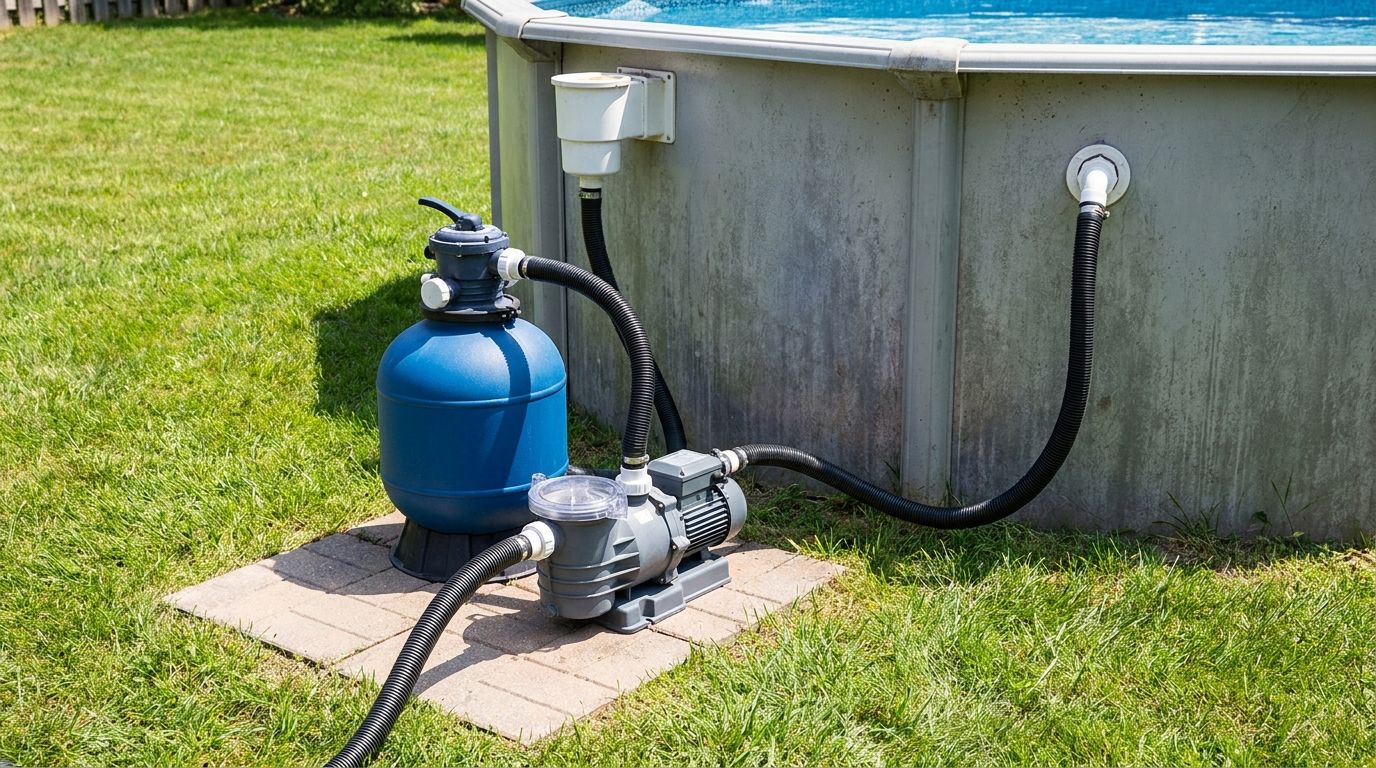
Above-ground pool pumps are a different product from in-ground pumps, and most of the bad purchases in this category come from not knowing that. An above-ground pump sits at or below water level, so it does not need to lift water; it needs to move a modest volume through a small filter without stirring up the bottom. That is why a $250 above-ground pump does the job on a 15,000-gallon above-ground pool that would need a $900 pump if it were in the ground.
This guide covers how to size an above-ground pump correctly, the three types you will actually see for sale, the models worth buying in 2026 from Intex, Bestway, Hayward, and Pentair, the mistakes that kill these pumps early, and where to buy without overpaying. If your pool is in-ground, this is the wrong page; start with the pool pump buying guide instead.
How to size an above-ground pool pump
The number you need is gallons per hour (GPH), not horsepower. The goal is to turn over the entire pool volume in about 8 hours, which means dividing your pool’s gallons by 8 to get the minimum GPH.
Quick volumes for common round above-ground pools at 48 inches of wall height: a 12-foot pool holds about 3,400 gallons, a 15-foot pool about 5,300, an 18-foot pool about 7,600, a 21-foot pool about 10,400, a 24-foot pool about 13,600, and a 27-foot pool about 17,200. Oval pools run about 20 to 30 percent less than the round pool of the same long dimension. The pool pump calculator does the exact math for your dimensions.
So an 18-foot round pool at 7,600 gallons needs roughly 950 GPH of real flow. Two cautions on that number. First, the GPH printed on the box is the pump’s open-flow rating, before the filter, hoses, and fittings slow it down; real flow through a cartridge filter is usually 60 to 70 percent of the box number. Second, more is not better. Oversizing an above-ground pump pushes water through the filter faster than the filter can clean it and can collapse a soft-sided pool’s return fitting. Pick the pump whose box rating is about 1.5 times your calculated GPH and stop there.
The three types of above-ground pump
Pump-and-cartridge-filter combos. The Intex Krystal Clear and Bestway Flowclear units are what ship with most soft-sided pools. The pump and a small cartridge filter share one housing. Cheap, quiet, plug into a standard outlet, and the cartridge is a $10 to $20 consumable you replace every few weeks in season. Right for pools under 10,000 gallons that get drained every fall.
Pump-and-sand-filter combos. A separate pump bolted to a sand filter tank on a shared base. Sand lasts 5 to 7 years, the filter handles bigger debris loads, and the pump is a real motor rather than a sealed cartridge unit. Right for 10,000-gallon and larger pools, pools with trees nearby, and any pool that stays up year-round.
Standalone pumps. A Hayward PowerFlo Matrix or Pentair OptiFlo bought on its own, plumbed to whatever filter you already own. This is the replacement path when the filter is fine and the pump has failed, and the upgrade path for owners moving off an Intex combo unit to a proper sand or cartridge filter.
The 2026 picks, by brand
Intex
Intex owns the entry tier. The Krystal Clear cartridge filter pumps come in 1,000, 1,500, 2,500, and 3,000 GPH sizes, retail $80 to $220, and match Intex pools by size on the box. The Krystal Clear sand filter pumps (1,200 to 3,000 GPH, $250 to $450) are the upgrade most Intex owners should make in their second season; the sand filter stops the every-week cartridge chore. Intex pumps use 1.25-inch or 1.5-inch hose fittings, and the 1.5-inch models are the ones to buy because adapters for everything else are easy to find.
Search Intex pool pumps on Amazon
Bestway
Bestway’s Flowclear line mirrors Intex at $20 to $60 less for the equivalent size: cartridge units at 530 to 2,500 GPH ($60 to $180) and sand filter systems at 1,000 to 2,200 GPH ($200 to $400). The trade-off is seal life. Flowclear pumps average two to three seasons of daily use before the pump seal weeps, versus three to four for the Intex equivalent. If you plan to keep the pool for more than two summers, the Intex price gap pays for itself; if this is a one-or-two-summer pool, Bestway is the value pick.
Search Bestway Flowclear pumps on Amazon
Hayward
The PowerFlo Matrix is the pump 80 percent of hard-sided above-ground owners end up with. 1 to 1.5 HP, a real strainer basket, 1.5-inch unions, retail $220 to $340 for the pump alone and $500 to $700 paired with a Hayward sand filter. It runs quieter and lasts longer than any combo unit and parts are on the shelf at every pool store. The full Hayward lineup, including the older PowerFlo LX that is often $50 cheaper for the same duty, is in the Hayward pool pump guide.
Shop above-ground pumps and filter systems at Doheny’s
Pentair
The OptiFlo is Pentair’s answer to the PowerFlo Matrix: 1 to 1.5 HP, $260 to $380 alone or $550 to $750 as a sand filter combo, and the same class of pump in every way that matters. Buy whichever of the two is cheaper the week you need it. The older Dynamo is still sold for replacement and runs about $40 less. Both are covered in the Pentair pool pump guide.
Search above-ground pool pumps on Amazon
Do you need a variable-speed pump for an above-ground pool?
Usually not. The Department of Energy rule that pushes in-ground pools toward variable-speed pumps applies to pumps above 1 total horsepower, and most above-ground pumps sit below that line. A single-speed PowerFlo Matrix draws about 800 to 1,100 watts, which at 8 hours a day is roughly $25 to $40 a month in season. A variable-speed above-ground pump costs $400 to $600 more and might save $15 a month for four or five months a year. The payback runs six to eight years, longer than most above-ground pools stay up.
The exception is a permanent hard-sided pool over 15,000 gallons in a hot climate that runs the pump 10-plus hours a day year-round. There, the math starts to look like an in-ground pool, and the variable-speed pool pump guide applies.
Five mistakes that kill above-ground pumps early
Running dry. The most common killer. The water level drops below the skimmer, the pump sucks air, and the seal overheats in minutes. Keep the water at the middle of the skimmer opening and never run the pump while filling.
Leaving it in the sun with no cover. The motor housing on a combo unit is plastic. A $15 pump cover or a shaded spot adds a season or two of life.
Not winterizing. Water left in the pump body freezes and cracks the housing. Drain it, store it indoors, and the pump lasts twice as long.
Ignoring the pressure gauge. On a sand filter system, a gauge reading 8 to 10 psi above the clean baseline means the filter needs a backwash, and the pump is working against a clogged filter until you do it.
Plugging into an extension cord. A long, thin extension cord drops the voltage, the motor runs hot, and the windings fail. Use a GFCI outlet within reach of the pump’s own cord, or have an outlet installed.
Common failures and what they cost to fix
On combo units, the honest answer is that most failures are not worth fixing: a new Intex sand filter pump costs $250 to $450 and a motor for one is not sold separately. On a standalone Hayward or Pentair pump, the failure list is the same as an in-ground pump at smaller prices. A start capacitor ($20 to $35) fixes most “hums but does not spin” complaints. A shaft seal kit ($25 to $40) fixes a drip between the motor and the wet end. A motor swap runs $150 to $250 in parts. If the pump is dead and you have not yet checked the capacitor, the pool pump repair diagnostic walks through it in order.
What to check before you replace, how to size it right, and how to avoid overpaying. One page, sent to your inbox.
No spam. Unsubscribe anytime. See our privacy policy.
FAQ
What size pump do I need for a 15-foot round pool? A 15-foot round pool at 48 inches holds about 5,300 gallons, so it needs about 660 GPH of real flow. An Intex 1,500 GPH cartridge unit or a 1,200 GPH sand filter pump is the right size. The 1,000 GPH unit is too small once the filter starts to load up.
What size pump do I need for an 18-foot or 24-foot pool? The 18-foot pool (about 7,600 gallons) wants a 2,000 to 2,500 GPH box rating; the 24-foot pool (about 13,600 gallons) wants a 3,000 GPH Intex sand unit or a 1 HP Hayward PowerFlo Matrix with a sand filter.
Can I use an in-ground pump on an above-ground pool? Yes, but it is usually a mistake. In-ground pumps are built to lift water and will pull too hard on a soft-sided pool’s fittings. If you have a hard-sided pool with the pump below water level, a 1 HP in-ground pump can work; anything above 1 HP will overpower the filter.
How long should I run an above-ground pool pump? 8 hours a day in season, split into two 4-hour runs if you can, and longer during a heat wave or after a storm. Running 24 hours a day is unnecessary for a correctly sized pump and doubles the electric bill.
Cartridge or sand filter? Sand for anything over 10,000 gallons, any pool near trees, or any pool you will keep up more than two seasons. Cartridge for small seasonal pools where the $10 replacement cartridge is easier than hauling 100 pounds of sand.
Can I leave the pump out over winter? Not in any climate that freezes. Drain it, store it indoors, and reconnect in spring. In a frost-free climate, keep it covered and run it a few hours a week to keep the seals wet.
The 60-second call
If you have an Intex or Bestway soft-sided pool under 10,000 gallons, buy the Intex Krystal Clear sand filter pump in the size that matches your pool. It is the single upgrade that makes these pools pleasant to own.
If you have a hard-sided above-ground pool of any size, buy the Hayward PowerFlo Matrix or Pentair OptiFlo with a sand filter, whichever is cheaper this week, from Doheny’s or a local pool store.
If your current pump has stopped, check the water level and the capacitor before you buy anything. Half of the “dead” above-ground pumps that get replaced every summer only needed water in the skimmer.
Last updated: 2026-09-03 by PoolPump.com. Prices reflect typical U.S. retail as of publish date and change by season and retailer. PoolPump.com is an independent guide and is not affiliated with Intex, Bestway, Hayward, or Pentair. Model names are trademarks of their owners.